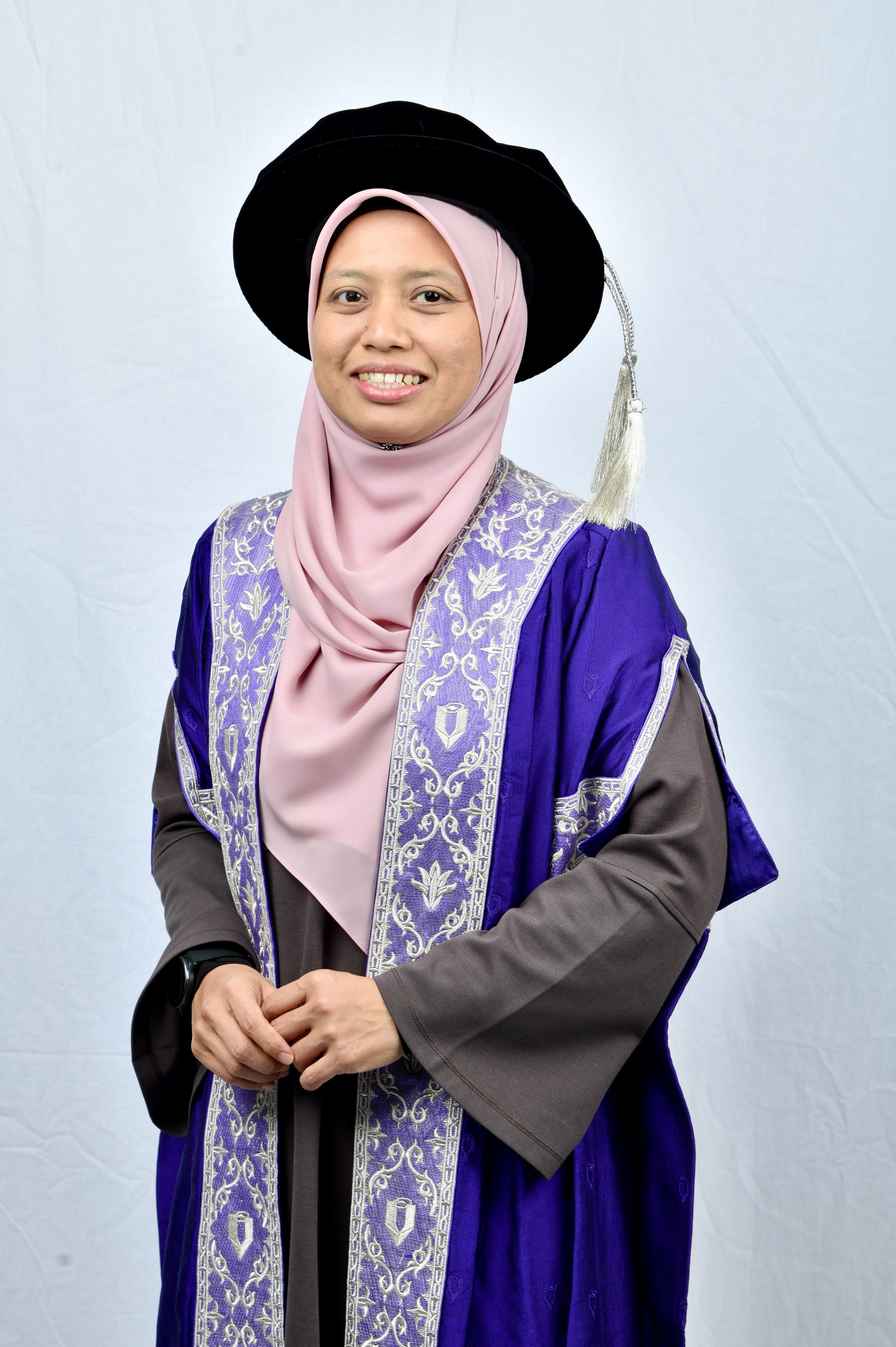
Professor Ts. Dr. Sumaiya binti Zainal Abidin@MuradDean and Professor
Faculty of Chemical and Process Engineering Technology
Universiti Malaysia Pahang Al-Sultan Abdullah
MALAYSIA
Faculty of Chemical and Process Engineering Technology
Universiti Malaysia Pahang Al-Sultan Abdullah
MALAYSIA
Prof. Ts. Dr. Sumaiya Zainal Abidin
Prof. Ts. Dr. Sumaiya Zainal Abidin is a Professor of Chemical Engineering and currently serves as the Dean of the Faculty of Chemical and Process Engineering Technology at Universiti Malaysia Pahang Al-Sultan Abdullah (UMPSA). She has over 18 years of academic and research experience, having begun her academic career in 2006. She received her PhD in Chemical Engineering from Loughborough University, United Kingdom, in 2012, following her MSc and BEng from Universiti Putra Malaysia. Her research expertise covers a wide spectrum including reaction engineering and catalysis (e.g., reforming, pyrolysis, esterification), renewable and sustainable energy (biodiesel, biofuels, hydrogen), advanced functional materials (catalysts, adsorbents, phase change materials), and separation technologies involving rare earth elements. She has successfully led or co-led more than 30 research projects funded by national and international agencies, often involving close collaboration with industry partners.
Prof. Ts. Dr. Sumaiya Zainal Abidin is a Professor of Chemical Engineering and currently serves as the Dean of the Faculty of Chemical and Process Engineering Technology at Universiti Malaysia Pahang Al-Sultan Abdullah (UMPSA). She has over 18 years of academic and research experience, having begun her academic career in 2006. She received her PhD in Chemical Engineering from Loughborough University, United Kingdom, in 2012, following her MSc and BEng from Universiti Putra Malaysia. Her research expertise covers a wide spectrum including reaction engineering and catalysis (e.g., reforming, pyrolysis, esterification), renewable and sustainable energy (biodiesel, biofuels, hydrogen), advanced functional materials (catalysts, adsorbents, phase change materials), and separation technologies involving rare earth elements. She has successfully led or co-led more than 30 research projects funded by national and international agencies, often involving close collaboration with industry partners.
Prof. Sumaiya has authored over 50 peer-reviewed journal articles in high-impact journals such as Fuel, Chemical Engineering Science, Industrial & Engineering Chemistry Research, International Journal of Hydrogen Energy, Journal of Environmental Chemical Engineering, and Minerals Engineering. She has also contributed one academic book, seven book chapters with renowned publishers (Elsevier, CRC Press, Springer, Taylor & Francis), and more than 40 refereed conference proceedings. She is the lead or corresponding author in numerous impactful works focusing on hydrogen-rich syngas production, catalyst development, and waste valorization. Several of her innovations have resulted in more than five patent filings and multiple recognitions at national and international research exhibitions.
She actively contributes to the scientific community as a Guest Editor for prestigious journals such as Comptes Rendus Chimie, International Journal of Hydrogen Energy, Materials Today: Proceedings, Chemical Engineering Research & Design, and SN Applied Sciences, and serves as a regular reviewer for high-impact journals by Elsevier, Springer, Wiley, and Taylor & Francis. Prof. Sumaiya is a Chartered Chemical Engineer awarded by the Institution of Chemical Engineers (IChemE), United Kingdom, and also holds the status of Professional Technologist (Ts) under the Malaysian Board of Technologists (MBOT), signifying her commitment to professional excellence and technological innovation. In recognition of her regional contributions and academic leadership, she was appointed in 2022 as a Visiting Professor at the Faculty of Chemical Engineering, Industrial University of Ho Chi Minh City, Vietnam, where she continues to foster international collaboration in research and education.
Title: Engineering the Future of Clean Syngas with Advanced Catalysis and Process Intensification
Catalytic steam reforming of biomass tar has been recognized as a highly effective process for converting harmful, complex hydrocarbons into clean, hydrogen-rich syngas. However, the advancement of this critical reforming technology continues to be hindered by persistent operational challenges. To systematically understand the evolution of this specific field and to uncover critical roadblocks, a comprehensive bibliometric analysis spanning the past 27 years (1997–2024) was conducted. Through this analysis, global research trajectories are mapped to reveal a significant research gap: the ongoing struggle to overcome rapid catalyst deactivation during the reforming process, which is primarily caused by severe carbon deposition (coking) and metal sintering.
A paradigm shift in catalyst development is demanded so that these gaps can be addressed. While excellent initial activity for breaking down complex tar molecules is exhibited by traditional monometallic catalysts, particularly Nickel-based systems, they are rendered highly vulnerable to deactivation over time. Broadening the scope beyond conventional systems, the engineering of highly robust, coke-resistant catalytic frameworks is explored in this presentation. To dramatically enhance catalyst stability, metal dispersion, and oxygen mobility, the integration of diverse transition metals (such as Cobalt, Iron, and Copper) and the design of advanced bimetallic synergies are highlighted, alongside the utilization of novel support materials like hollow-structured biochar and perovskites.
Furthermore, the latest technological advancements by which biomass tar reforming is being transformed are spotlighted so that the boundaries of current limitations can be pushed. Moving beyond traditional high-temperature steam reforming, process intensifications integrating innovative energy inputs are explored. These include photothermal catalytic reforming (PCR), wherein both UV light and heat are uniquely harnessed so that coking is suppressed and high-efficiency reactions are driven at lower temperatures; microwave-driven steam reforming, by which rapid, localized volumetric heating is generated to reduce activation energy; and non-thermal plasma-assisted reforming, where high-energy electrons are utilized so that stubborn tar bonds are broken down and catalyst performance is enhanced.
Ultimately, by bridging the historical insights of the bibliometric analysis with the forefront of catalyst design and emerging hybrid technologies, the development of highly efficient, sustainable, and commercially scalable solutions for clean hydrogen-rich syngas production can be significantly accelerated.