Prof. Mingheng LiProfessor
College of Engineering
California State Polytechnic University
UNITED STATES
College of Engineering
California State Polytechnic University
UNITED STATES
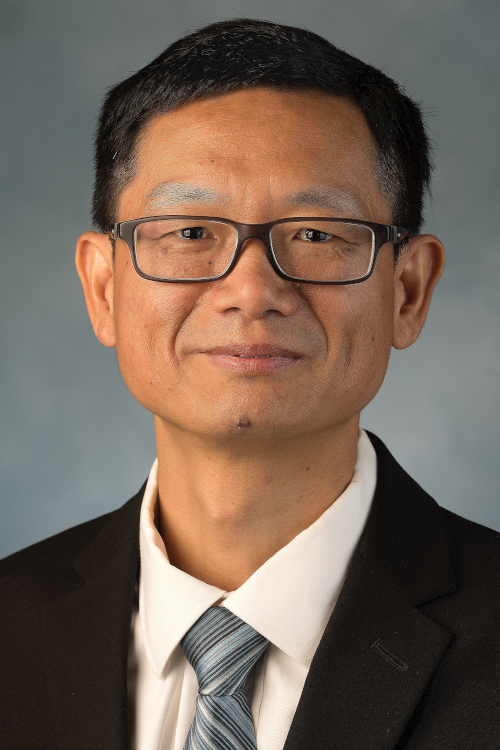
Prof. Mingheng Li
Prof. Mingheng Li is a leading expert in water desalination and membrane technologies, with over 15 years of research experience in high-recovery reverse osmosis, dynamic membrane processes, and energy-efficient water treatment systems. His work bridges fundamental modeling and real-world applications and has contributed to several technologies that have advanced to pilot and commercial stages. Dr. Li holds a faculty position in chemical engineering at California State Polytechnic University Pomona, where he conducts interdisciplinary research at the intersection of separation science, artificial intelligence, and sustainable energy systems. He has published over 80 peer-reviewed papers and three books, including a monograph on membrane system design.
Prof. Mingheng Li is a leading expert in water desalination and membrane technologies, with over 15 years of research experience in high-recovery reverse osmosis, dynamic membrane processes, and energy-efficient water treatment systems. His work bridges fundamental modeling and real-world applications and has contributed to several technologies that have advanced to pilot and commercial stages. Dr. Li holds a faculty position in chemical engineering at California State Polytechnic University Pomona, where he conducts interdisciplinary research at the intersection of separation science, artificial intelligence, and sustainable energy systems. He has published over 80 peer-reviewed papers and three books, including a monograph on membrane system design.
Title: A Unified Spatiotemporal Modeling Framework for Emerging Reverse Osmosis Technologies
Emerging reverse osmosis (RO) technologies increasingly operate under transient and cyclic conditions driven by high-recovery desalination, zero-liquid discharge (ZLD), and renewable-energy integration. These dynamic operating modes introduce complex spatiotemporal salt redistribution phenomena that cannot be adequately captured by conventional steady-state RO models. This talk presents a unified spatiotemporal modeling framework for dynamic and cyclic RO systems by coupling transient water transport, salt transport, hydraulic behavior, and axial dispersion within membrane channels. The framework provides mechanistic insight into important phenomena observed in cyclic RO operation, including concentration overshoot, imperfect flushing, salt retention, and hysteresis effects. Applications to closed-circuit RO (CCRO), flow-reversal RO (FRRO), variable-configuration RO (VCRO), and wave-powered RO systems will be discussed. Results demonstrate how transient salt dynamics influence recovery, energy consumption, and operational stability, while also revealing opportunities for process optimization and adaptive control. The talk concludes with perspectives on integrating physics-based spatiotemporal models with smart control strategies and artificial intelligence for next-generation desalination systems.